
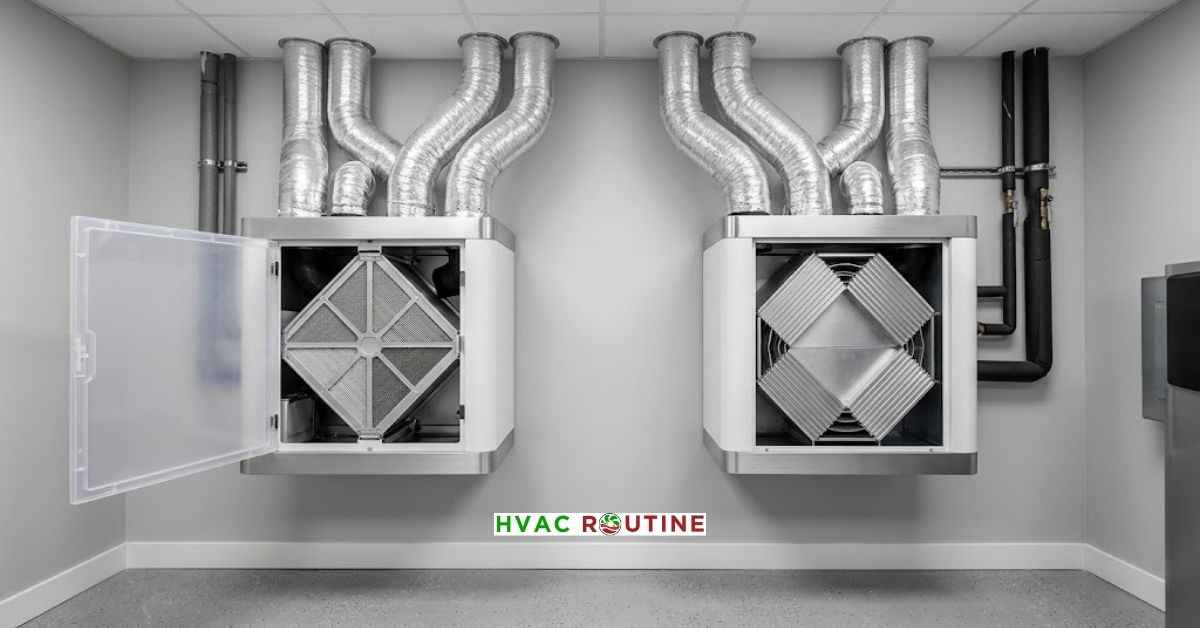
Modern energy-efficient building techniques seal homes tighter than ever before. These airtight envelopes slash heating and cooling bills, but they also trap stale air, volatile organic compounds, and excess humidity inside living areas.
When homeowners weigh a heat recovery ventilator vs energy recovery system, they need to understand how each technology handles moisture and thermal loads.
Both mechanical systems pull continuous streams of fresh outdoor air into the house while expelling contaminated indoor air.
They exchange energy between these two airstreams so your furnace and air conditioner do not work overtime.
However, their internal exchange cores treat moisture in fundamentally different ways.
What You'll Learn ⭐⭐⭐⭐⭐
- Maintenance Toolkit, Safety Rules, and Inspection Steps
- Heat Recovery Ventilator vs Energy Recovery: How Each Core Works
- Side-by-Side System Comparison
- Sensible vs Latent Heat: The Engineering Science
- Climate Selection: Matching Units to Regional Weather
- Cold Northern Climates (IECC Zones 5 Through 7)
- Hot and Humid Southern Climates (IECC Zones 1 Through 3)
- Mixed Climates (IECC Zone 4)
- Energy Cost Comparison: Chicago vs Atlanta
- Sizing and Duct Layout Using ASHRAE 62.2
- Dedicated Duct Runs vs Central HVAC Tie-In
- Filtration, Equipment Costs, and Payback
- Filter Grades and Pressure Balance
- Equipment and Installation Costs
- Top Market-Leading Brands and Model Recommendations
- Brand and Model Comparison
- Practical Questions and Real Scenarios
Maintenance Toolkit, Safety Rules, and Inspection Steps
Tools Required
- Digital differential manometer or Magnehelic gauge for measuring static pressure.
- 5/16-inch magnetic nut driver and standard screwdriver set.
- Wet/dry shop vacuum with a soft brush attachment.
- Digital multimeter for testing fan voltage.
- Clean bucket, warm tap water, and mild dish soap.
- Fresh MERV 8 to MERV 13 replacement air filters.
Safety Warnings
- Disconnect main electrical power at the breaker before opening the unit cabinet.
- Avoid using compressed air on delicate enthalpy exchange cores.
- Never wash an ERV core with water unless the manufacturer label explicitly permits wet cleaning.
- Inspect the drain pan for standing water to prevent microbial growth.
Step-by-Step Seasonal Maintenance
- Shut off electrical power to the ventilation cabinet.
- Open the access door latches and remove the primary intake and exhaust filters.
- Slide the exchange core gently out of its mounting tracks.
- Vacuum dry dust from an ERV core with a soft brush nozzle.
- Rinse an aluminum HRV core in warm water and allow it to dry completely.
- Flush the condensation drain pipe with a mild vinegar solution.
- Clear outdoor intake and exhaust hoods of leaves, spider webs, and debris.
- Reinstall all components, secure the cabinet door, and restore power.
When to Call a Professional
- Airflow measurements show a pressure imbalance exceeding 10% between supply and exhaust streams.
- The blower motor emits screeching, whining, or grinding sounds.
- The automatic defrost damper fails to cycle during freezing weather.
Heat Recovery Ventilator vs Energy Recovery: How Each Core Works
Heat Recovery Ventilators (HRV)
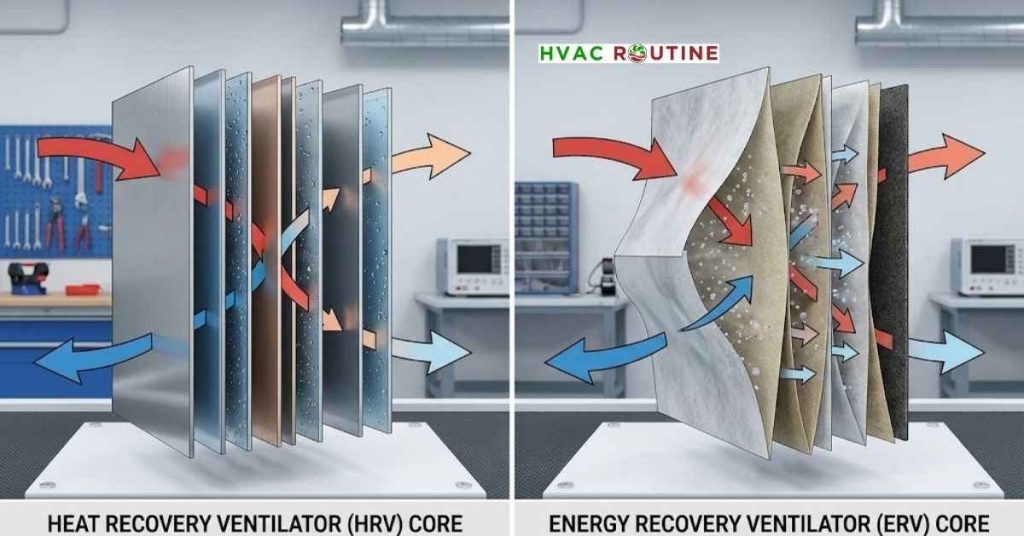
An HRV transfers sensible heat across thin plates made of aluminum or polypropylene.
During freezing winter months, warm exhaust air from your bathrooms and kitchen passes through alternating channels in the core.
The outgoing air warms the cold outdoor supply air without letting the two airstreams physically mix.
An HRV transfers temperature only, leaving water vapor behind.
Because warm indoor air cools down rapidly inside the core, moisture condenses against the plates.
Every HRV requires a dedicated condensate drain line to route this liquid away from the unit.
In the summer, the process reverses as cold exhaust air pre-cools incoming hot outdoor air.
Energy Recovery Ventilators (ERV)
An ERV uses an enthalpy exchange core made from special polymer resins or treated cellulose membranes.
These permeable membranes allow microscopic water molecules to transfer between airstreams alongside sensible heat.
During winter, the outgoing humid air transfers both heat and water vapor to the dry, cold outdoor air entering your home.
This moisture retention keeps indoor relative humidity in a comfortable 35% to 50% range.
During humid summer months, the ERV membrane strips moisture from the muggy outdoor air and sends it right back outside with the exhaust stream.
By blocking incoming humidity, an ERV removes a heavy latent load from your central air conditioning unit.
Side-by-Side System Comparison
| Feature | Heat Recovery Ventilator (HRV) | Energy Recovery Ventilator (ERV) |
| Energy Transferred | Sensible heat only (temperature) | Total enthalpy (sensible heat + latent moisture) |
| Moisture Action | Condenses moisture into a drain pan | Transfers water vapor across permeable core |
| Condensate Drain | Always required | Only required in extreme cold or deep humid zones |
| Winter Indoor Air | Dries out indoor air spaces | Keeps indoor humidity balanced |
| Summer AC Impact | Lets outdoor humidity enter the home | Blocks outdoor humidity from entering |
| Sensible Efficiency | 65% to 85% SRE | 60% to 80% SRE |
Sensible vs Latent Heat: The Engineering Science
HVAC engineers evaluate heat recovery ventilator vs energy recovery units by calculating both temperature differences and humidity shifts.
Sensible heat refers to the thermal energy that changes dry-bulb air temperature without changing moisture content.
You calculate sensible heat transfer using this standard formula:
Latent heat represents the hidden energy stored within evaporated water vapor.
Water requires roughly 1,061 BTUs of thermal energy to evaporate a single pound of liquid into vapor.
When humid air enters a house during July, your air conditioner spends substantial electricity just condensing that water vapor before it can lower room temperatures.
An ERV intercepts this latent load at the exterior wall, dropping your cooling costs.
Climate Selection: Matching Units to Regional Weather
Cold Northern Climates (IECC Zones 5 Through 7)
Homeowners in places like Minnesota, Maine, and Canada experience prolonged sub-zero winters.
If your home accommodates a large family that cooks often and takes long showers, indoor moisture levels climb quickly.
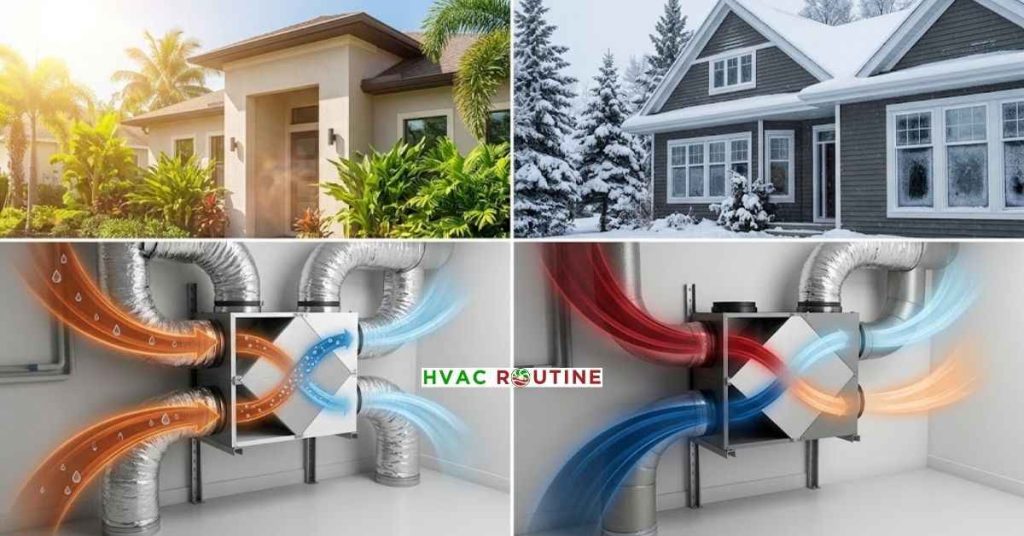
An HRV acts as a controlled dehumidifier in these conditions by dumping excess moisture outside.
This moisture extraction prevents window condensation, frost buildup on sills, and mold growth in wall assemblies.
However, small households in dry northern regions often suffer from cracked skin, dry sinuses, and static shocks when using an HRV.
In those dry homes, an ERV preserves existing indoor moisture and maintains comfortable air quality.
Hot and Humid Southern Climates (IECC Zones 1 Through 3)
In states like Florida, Texas, and Georgia, outdoor humidity remains high for eight months of the year.
Installing an HRV in these zones forces your central air conditioner to battle constant outdoor humidity spikes.
An ERV solves this challenge by blocking outdoor moisture before it enters living spaces.
The ERV core transfers incoming humidity directly into the outgoing exhaust airstream.
This process keeps indoor relative humidity below the 60% mold threshold and protects drywall from moisture rot.
Mixed Climates (IECC Zone 4)
Regions like the Mid-Atlantic and Pacific Northwest experience cold winters and humid summers.
In these balanced climates, the home’s airtightness rating dictates the right choice.
A home testing below 2.0 Air Changes per Hour at 50 Pascals (ACH50) benefits most from an ERV because tight walls retain very little natural vapor flow.
Energy Cost Comparison: Chicago vs Atlanta
- Chicago Home (2,200 sq. ft., Zone 5):
- An HRV saves approximately $180 annually on natural gas heating bills by recovering sensible heat from exhaust air.
- An ERV saves approximately $165 on heating bills while eliminating the need for a 300-watt whole-house humidifier during dry winter months.
- Atlanta Home (2,200 sq. ft., Zone 3):
- An HRV increases summer air conditioning electricity bills by $75 because it pulls muggy outdoor air into the conditioned space.
- An ERV saves approximately $130 per year by rejecting outdoor humidity before it reaches the air handler coil.
Sizing and Duct Layout Using ASHRAE 62.2
The American Society of Heating, Refrigerating and Air-Conditioning Engineers (ASHRAE) sets continuous ventilation rates in standard 62.2.
You calculate whole-building continuous ventilation rates with this standard formula:
Consider a single-family home with 2,000 square feet of floor area and 3 bedrooms.
Multiply 2,000 by 0.03 to get 60 CFM.
Add 1 to the 3 bedrooms to get 4, then multiply by 7.5 to get 30 CFM.
Add 60 and 30 together to find your target continuous airflow rate of 90 CFM.
Dedicated Duct Runs vs Central HVAC Tie-In
A dedicated duct system provides the highest ventilation performance.
Dedicated ducts pull stale, moist air directly from bathrooms and kitchens through dedicated pick-up grilles.
The unit then delivers tempered, fresh air straight to bedrooms and living spaces through separate ceiling registers.
This layout runs completely independent of your main furnace fan, cutting electrical consumption.
Simplified installations connect the ventilator directly into your existing HVAC return plenum.
While a simplified tie-in reduces upfront installation labor, it requires interlocking controls to run the central air handler fan whenever fresh air cycles.
Filtration, Equipment Costs, and Payback
Filter Grades and Pressure Balance
Ventilator cabinets house internal slide-in filters that protect the exchange core and clean incoming air.
Standard MERV 8 filters capture pollen, lint, and large dust particles without creating high air resistance.
Upgrading to a MERV 13 filter captures fine wildfire smoke, vehicle soot, and airborne bacteria.
However, higher MERV filters create higher static resistance across the blower wheels.
Use a digital manometer to measure total external static pressure after installing new filters.
Maintain balanced pressure between intake and exhaust fans to prevent pulling unconditioned air through wall outlets and ceiling fixtures.
Equipment and Installation Costs
- Entry-Level Units (50 to 100 CFM): $700 to $1,100 for hardware alone.
- High-Efficiency Variable-Speed Units (150 to 250 CFM): $1,400 to $2,400 with ECM motors and automated defrost controls.
- Professional Installation Labor: $1,200 to $3,000 depending on duct access, exterior wall coring, and electrical wiring.
- Average Payback Period: Most homeowners recoup the cost difference over standard exhaust-only fans within 5 to 8 years through reduced heating and cooling loads.
Top Market-Leading Brands and Model Recommendations
Selecting the right hardware depends on your budget, structural duct access, and energy efficiency targets.
Budget-Friendly Whole-House Units: Broan-NuTone and Fantech
Broan-NuTone builds dependable, contractor-grade HRVs and ERVs that drop directly into standard residential duct layouts.
Their units feature straightforward mechanical wall controls and slide-out washable filters that keep long-term maintenance costs low.
Fantech manufactures compact VHR and FIT series ventilators designed for tight mechanical rooms and ceiling drop-downs.
Fantech units deliver consistent airflow balancing through built-in pressure taps and durable backward-curved fan impellers.
High-Efficiency and Passive House Standards: Zehnder ComfoAir
Zehnder sets the global benchmark for high-performance home building with its ComfoAir Q series.
These systems achieve up to 90% sensible heat recovery efficiency while consuming less fan electricity than a standard household LED light bulb.
Zehnder integrates automated summer bypass dampers, modulated pre-heaters, and state-of-the-art enthalpy cores for complete moisture management.
If you build an airtight Passive House or want silent ventilation in living areas, Zehnder provides unmatched engineering.
Compact Spot and Single-Room Ventilation: Panasonic WhisperComfort
Panasonic WhisperComfort provides a dedicated ceiling-mount ERV solution for spaces lacking central ductwork.
This spot-ventilation unit fits between standard ceiling joists and handles 20 to 40 CFM of balanced airflow.
It utilizes dual-orifice capillary technology to transfer temperature and humidity directly through a compact exterior wall termination.
It works exceptionally well for retrofitting studio apartments, basement home offices, and master bathroom suites.
Brand and Model Comparison
| Brand & Series | Unit Category | Airflow Range | Core Type | Best Use Case |
| Broan-NuTone HRV/ERV | Whole-House Entry | 70 to 160 CFM | Sensible Plate / Poly Resin | Budget-focused retrofits and standard builds |
| Fantech VHR / FIT | Whole-House Mid-Range | 100 to 200 CFM | Aluminum / Polymer Enthalpy | Tight mechanical spaces and custom duct setups |
| Zehnder ComfoAir Q | High-Performance Premium | 160 to 350 CFM | High-Capacity Enthalpy Core | Passive House, high-efficiency custom homes |
| Panasonic WhisperComfort | Spot / Single-Room | 20 to 40 CFM | Dual Capillary ERV Core | Additions, studio condos, and home offices |
Practical Questions and Real Scenarios
Can you use an HRV in a home with a wood stove or fireplace?
Wood stoves consume indoor air during combustion and pull extra room air up the chimney flue.
An unbalanced exhaust fan creates negative indoor air pressure, drawing dangerous carbon monoxide down the chimney.
A balanced HRV supplies exactly as much fresh air as it exhausts, maintaining neutral indoor pressure.
Homeowners in cold climates with wood heat often prefer an ERV to counteract the intense drying effect of wood stoves.
How does household size change system selection?
A family of five living in a 1,800-square-foot home generates up to 25 pounds of water vapor daily through breathing, cooking, and showering.
In cold northern climates, this high-moisture household needs an HRV to vent that heavy vapor load outdoors.
Conversely, a retired couple living in a large 3,500-square-foot house produces very little daily moisture.
Installing an HRV in that large house drives indoor winter humidity down to uncomfortably dry 15% levels.
That couple needs an ERV to conserve their limited indoor moisture.
How do you protect your ventilation system during wildfire season?
Heavy outdoor wildfire smoke carries dangerous PM2.5 particulates that penetrate standard mesh screens.
When smoke blankets your neighborhood, switch your ventilator control into recirculation mode or low-speed filtration.
Equip the fresh air intake slot with a certified MERV 13 or HEPA filter module to clean incoming air before it reaches bedrooms.
Choosing a heat recovery ventilator vs energy recovery ventilator comes down to your local climate and your family’s daily moisture output.
Select an HRV if you live in a heating-dominated northern climate and battle persistent winter window condensation.
Choose an ERV if you live in a humid southern climate, a mixed transitional climate, or a tight modern home that suffers from dry winter air.
Matching the right recovery core to your house structure guarantees clean indoor air, balanced humidity, and steady energy savings all year long.

3 thoughts on “Heat Recovery Ventilator vs Energy Recovery: The Complete Home Ventilation Guide”