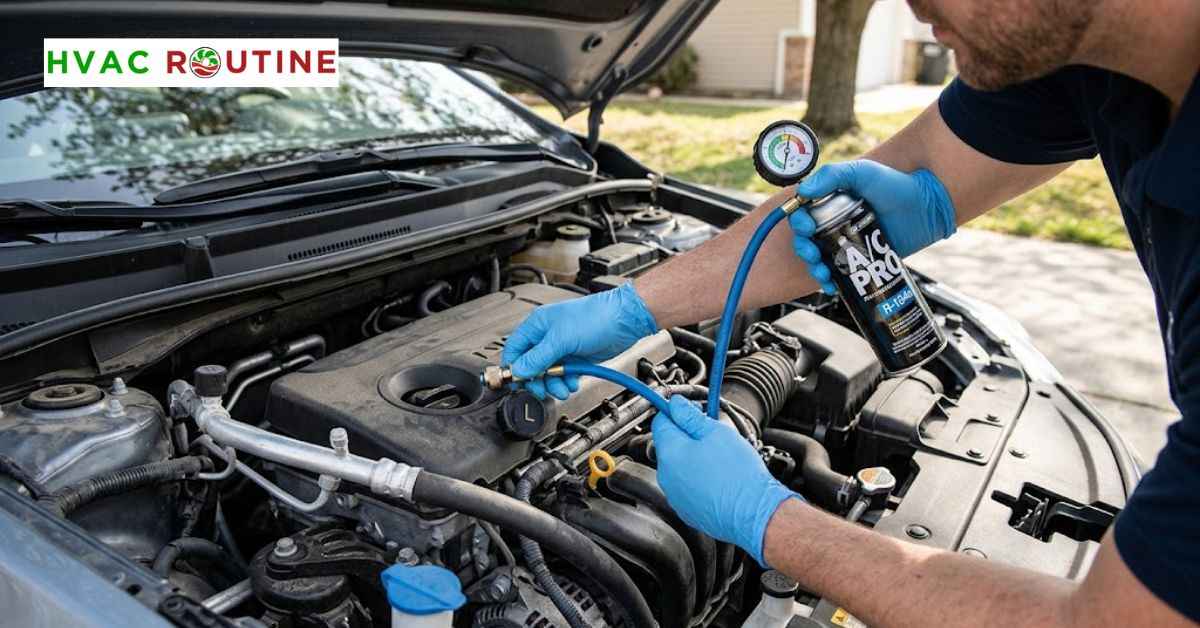
Summer heat turns a vehicle with a broken air conditioner into a rolling oven. You press the AC button, hoping for a blast of cold air, but only get hot, stale wind in your face. Honestly, this frustration drives thousands of drivers to look up how to recharge an AC in a car every single summer. I once helped a neighbor who completely locked up his compressor because he watched a quick video and blindly guessed his system pressure.
The good news is you can safely restore that crisp, cold air yourself without guessing. You just need the right tools, a bit of patience, and clear instructions. In this guide, we will walk through the entire process together, from checking the baseline pressure to measuring the final temperature drop at your dashboard vents.
Tools Required:
- The correct refrigerant type for your specific vehicle.
- A refrigerant recharge kit with an attached low-pressure gauge.
- A clean shop rag to wipe away grease and dirt.
- Heavy-duty mechanic gloves to protect your hands.
- Protective safety goggles to shield your eyes.
- A digital HVAC thermometer for testing cabin vents.
Safety Warnings:
I know dealing with pressurized gas sounds scary, but as long as you wear your safety gear and pay attention, you have nothing to worry about. Refrigerant freezes skin and eyes instantly upon contact, so never skip the gloves and goggles. Additionally, never connect a standard recharge kit to the high-pressure line. Attaching a can to the high side forces high-pressure gas back into the can, causing it to explode. Finally, remember that the Environmental Protection Agency (EPA) strictly prohibits venting refrigerant directly into the atmosphere.
What You'll Learn ⭐⭐⭐⭐⭐
- Cost and Time Comparison: DIY vs. Mechanic
- Identify the Correct Refrigerant for Your Vehicle
- Prepare the Vehicle for Accurate Pressure Testing
- How to Recharge an AC in a Car
- Step 1: Start the Engine and Maximize AC Settings
- Step 2: Read the Baseline System Pressure
- Step 3: Factor in Ambient Air Temperature
- Step 4: Dispense the Refrigerant in Short Bursts
- Step 5: Watch the AC Compressor Clutch Engage
- Step 6: Verify Cabin Vent Temperatures
- The Necessity of Vacuuming an Empty System
- Immediate Solutions for Incorrect Recharge Mistakes
- How to Safely Dispose of Empty Refrigerant Cans
- Advanced Diagnostics: Leveraging Auto Tech for HVAC Issues
- Routine Maintenance to Prevent Gas Leaks
- When to Call a Pro
- Common Auto AC Recharging Queries
- Why does my car AC blow cold air for ten minutes and then turn warm?
- Key Takeaways
Cost and Time Comparison: DIY vs. Mechanic
Taking your car to a professional shop costs anywhere from $150 to $300 for a standard AC service. Mechanics charge high labor rates just to hook up their recovery machines and fill the system. On the other hand, doing this job yourself takes only 20 to 30 minutes right in your driveway. You only spend $40 to $60 on a quality recharge kit from a local auto parts store, saving yourself hundreds of dollars instantly.
Identify the Correct Refrigerant for Your Vehicle
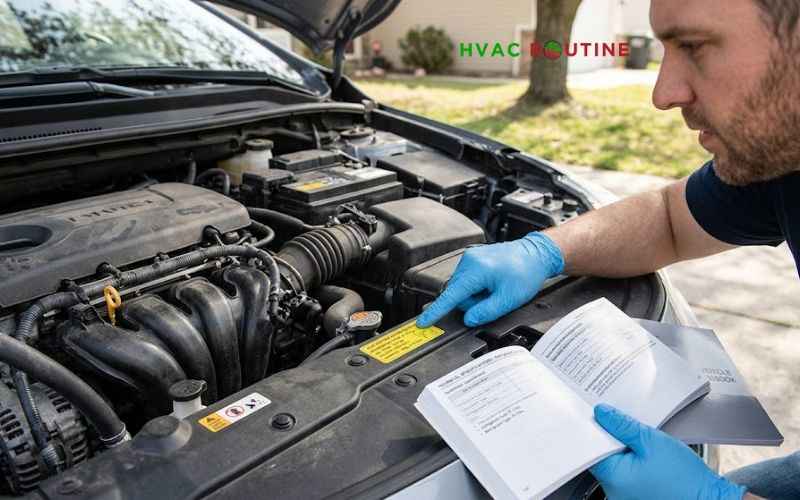
Read the Under-Hood AC Specification Label
Before you buy anything, open your hood and look for the factory HVAC sticker. Automakers usually place this label on the radiator core support or underneath the hood itself. This sticker clearly tells you the exact refrigerant chemistry your system requires and the total fluid capacity.
The Tech Difference: R-134a vs. R-1234yf
Older vehicles run on an R-134a Freon system, while most new cars built after 2014 use the environmentally friendly R-1234yf standard. You cannot mix these two chemicals under any circumstances. Mixing refrigerants contaminates the internal oil, destroys the compressor, and ruins the entire cooling loop.
Prepare the Vehicle for Accurate Pressure Testing
Park in a Shaded, Well-Ventilated Area
Always move your car into the shade before you start working. Direct sunlight actively heats up the engine bay and the metal AC lines, which skews your pressure gauge accuracy. You need a stable baseline reading based on the true ambient air temperature.
Locate the Low-Pressure Service Port
Your AC system features two distinct aluminum lines. The low-pressure service port sits on the thicker pipe, while the high-pressure line uses a much thinner pipe and a larger port. Manufacturers design recharge kits to only fit the low-pressure side, preventing accidental mix-ups.
Before attaching anything, take your clean rag and wipe the dust and grease off the service port. Forcing dirt into the AC system instantly clogs the microscopic tubes inside the expansion valve.
How to Recharge an AC in a Car
Step 1: Start the Engine and Maximize AC Settings
Start your engine and let it idle normally. Turn your AC to the coldest possible temperature setting and crank the blower fan to the highest speed. Make sure to press the recirculation button to block warm outside air from entering the cabin.
Step 2: Read the Baseline System Pressure
Snap the quick-connect fitting onto the low-pressure port and look at the gauge before you pull the trigger. Here is the catch: you need to listen to your AC compressor while reading the dial. If the compressor turns on for two seconds and then immediately turns off, it is short cycling. Short cycling stands as a classic symptom of low refrigerant pressure. Conversely, if your pressure reading shows absolute zero, you have a massive mechanical leak that a can of freon will not fix.
Step 3: Factor in Ambient Air Temperature
Outside heat directly dictates the target PSI inside your cooling system. Check the ambient air temperature chart below to find your exact target number before adding any gas.
Step 4: Dispense the Refrigerant in Short Bursts
Squeeze the trigger for five to ten seconds at a time. Shake the can up and down while you hold the trigger, and rotate it slowly between the 12 o’clock and 3 o’clock positions to keep the liquid flowing smoothly. Release the trigger to read the accurate system pressure on the dial. Repeat this process patiently until the needle reaches the target pressure for your specific outside temperature.
Step 5: Watch the AC Compressor Clutch Engage
Look down at the AC compressor running off the engine belt. You want to see the front plate of the AC compressor clutch spin continuously. The clutch will click loudly and start spinning once the system builds enough pressure. This solid engagement tells you the compressor works and the dreaded short cycling has finally stopped.
Step 6: Verify Cabin Vent Temperatures

Take your digital HVAC thermometer and slide it directly into the center dashboard vent. Watch the numbers drop as the system cycles the new gas. A healthy system creates a significant vent temperature drop, usually pushing out readings between 40 and 45 degrees Fahrenheit even on a blisteringly hot day.
The Necessity of Vacuuming an Empty System
Many drivers ask if they can simply add freon to a completely empty AC system. The short answer is no. An empty system means outside air and moisture have already entered the cooling loop. Water inside the lines turns into a corrosive acid that quietly destroys internal metal parts. You must hook up a vacuum pump to boil off the moisture and remove the air before adding any new gas. If your gauge reads absolute zero, take the car to a shop for a proper vacuum and leak test.
Immediate Solutions for Incorrect Recharge Mistakes
Mistakes happen when working on cars, but AC systems require immediate action if things go wrong. If you accidentally force the quick-connect fitting onto the high-pressure port, the can will swell and explode. You must immediately drop the can, step away from the vehicle, and let the pressure equalize safely.
Alternatively, adding too much refrigerant causes a system overcharge, making the compressor whine loudly while blowing warm air. You cannot just bleed the extra gas into the open air to lower the pressure. You must drive the car to a certified mechanic so they can recover the excess pressure safely with an approved AC machine.
How to Safely Dispose of Empty Refrigerant Cans
Environmental laws strictly regulate automotive chemical disposal. Never throw a partially full can of refrigerant into your household trash. You can safely recycle the metal can only after it is completely empty and fully depressurized. For cans that still contain leftover gas, contact your local hazardous waste facility for safe drop-off instructions.
Advanced Diagnostics: Leveraging Auto Tech for HVAC Issues
If your AC still acts up, use the table below to quickly diagnose what your car tries to tell you based on the symptoms.
Reading Live Data with an OBD2 Scanner
Modern automotive HVAC diagnostics let you see exactly what the car’s computer sees. Plug a diagnostic scanner into your OBD2 port under the steering wheel. This allows you to read live voltages from the pressure sensors and monitor exact temperature data from the evaporator in real-time.
Understanding Manifold Gauge Set Readings
Professional mechanics use a full AC manifold gauge set to read both sides of the system simultaneously. The high side tells you how hard the compressor pumps the gas, while the low side shows you how much gas returns from the cabin. Watching these two numbers together helps you pinpoint blockages or verify a failing compressor.
Routine Maintenance to Prevent Gas Leaks
Surprisingly, most drivers never touch their AC button during the freezing winter months. This lack of use actually causes the rubber O-rings in your AC lines to dry out and shrink. Shrunken seals allow tiny amounts of refrigerant to silently leak out over the winter. You can prevent this easily by running your air conditioner for ten minutes every two weeks year-round. This simple habit circulates the internal PAG lubricating oil and keeps all the rubber seals plump, tight, and leak-free.
When to Call a Pro
The System Will Not Hold Vacuum or Pressure
You might hear a distinct hissing sound the moment you add refrigerant. This sound clearly indicates a cracked line or a busted O-ring. A shop must pull an AC system vacuum to test for these hidden leaks. They use ultraviolet dye and specialized sniffer tools to find tiny holes buried deep in the evaporator core.
The Compressor Clutch Refuses to Engage
Sometimes the system holds perfect pressure, but the compressor simply ignores it. In this scenario, you likely have a blown AC relay, a bad pressure switch, or a dead compressor coil. These electrical faults require multimeters and factory wiring diagrams to track down properly.
Common Auto AC Recharging Queries
Why does my car AC blow cold air for ten minutes and then turn warm?
Moisture trapped inside the refrigerant loop causes this specific and highly annoying problem. Water droplets travel through the lines and freeze solid the moment they hit the expansion valve. This ice block completely stops the flow of cold air into the cabin. The ice melts after ten minutes of blowing warm air, and the frustrating cycle repeats itself. A mechanic must evacuate the entire system and replace the receiver drier to fix this issue permanently.
Can overcharging the AC system permanently damage the compressor?
Yes, adding too much pressure forces the compressor to work against impossible physical resistance. Think of it like trying to pump air into a tire that is already completely full. The internal compressor valves bend under the extreme load. Eventually, the metal parts shatter and send destructive metal shrapnel through every single hose in your car.
How often should an average vehicle need a refrigerant top-off?
A perfectly sealed auto AC system never actually needs a top-off. Your home refrigerator runs for twenty years without needing more freon because it uses solid copper lines. However, cars use flexible rubber hoses that naturally expand, contract, and leak tiny amounts of gas over several years of driving. Under normal conditions, you should only need to add a few ounces of refrigerant every three to five years.
Does AC pro stop-leak actually work for permanent repairs?
Stop-leak products swell rubber O-rings to temporarily plug small holes, creating a quick fix that might last a single summer. However, the chemical hardens instantly when it contacts moisture, completely clogging the microscopic tubes inside your condenser. Professional shops often refuse to service cars filled with stop-leak because the glue ruins their expensive recovery machines.
Key Takeaways
Always check your ambient temperature chart before you squeeze the trigger to avoid overcharging. Wipe down your low-pressure port thoroughly to keep system-destroying dirt out of the lines. Make sure you verify your specific refrigerant type on the under-hood sticker to avoid catastrophic chemical contamination.
Run your AC briefly during winter months to keep the rubber seals lubricated. Finally, remember that learning how to recharge an AC in a car only treats the symptom of warm air. A completely empty system always points to a larger mechanical leak that requires real replacement parts.