
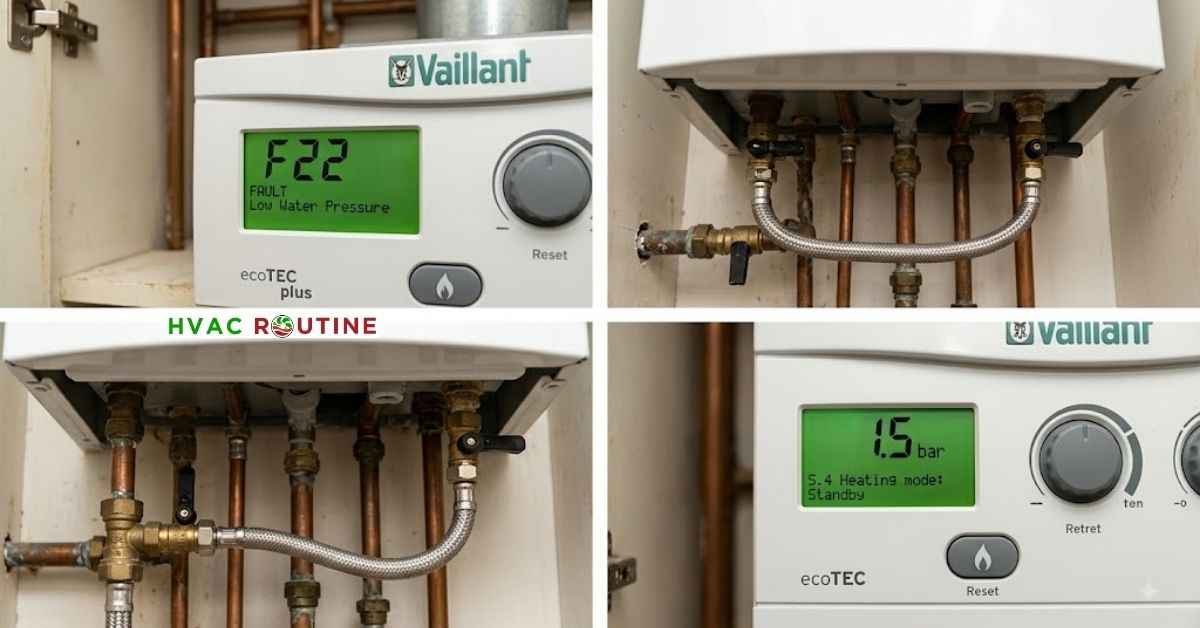
You wake up on a freezing morning, turn on your shower, and get blasted with ice-cold water. You check your hallway utility closet and find a flashing error panel on your heating unit.
Finding a quick Vaillant boiler F22 fault code fix restores your hot water without waiting hours for help. This specific warning light means your heating system dropped below its safe operating water pressure.
You can resolve this issue in under ten minutes using basic items from your toolbox.
What You'll Learn ⭐⭐⭐⭐⭐
- Tools Required for Vaillant Boiler F22 Fault Code Fix:
- Safety Warnings
- Step-by-Step Fixes
- When to Call a Pro
- What Causes the F22 Warning on Vaillant Boilers?
- Step-by-Step Vaillant Boiler F22 Fault Code Fix for Homeowners
- Bleeding Radiators and Correcting Water Drop
- Why Your Central Heating Pressure Loss Keeps Happening
- F22 vs F75 Error Code Differences Explained
- Choosing the Correct Repair Path
- Advanced Plumbing Issues Behind Chronic Pressure Drop
- Key Action Steps to Keep Your Heating System Running Smoothly
- FAQ
- Still have more questions?
Tools Required for Vaillant Boiler F22 Fault Code Fix:
- A standard radiator bleed key.
- A clean microfiber cloth to catch stray water drops.
- A flathead screwdriver or internal key for your specific model.
- A small flashlight to view dark pipework underneath the unit.
Safety Warnings
- Always switch off electrical power to the unit before touching valves or external pipe connections.
- Allow bare heating pipes to cool down completely to avoid accidental skin burns.
- Never force stuck plastic levers or brass handles when turning valves.
- Stop immediately if you notice pooling water inside the main casing or smell fuel.
Step-by-Step Fixes
- Step 1: Locate the current pressure reading on your digital screen or analogue dial.
- Step 2: Attach the flexible silver hose beneath your unit if it remains detached.
- Step 3: Turn both small handles slowly until you hear running water entering the system.
- Step 4: Watch the screen until the reading reaches 1.2 to 1.5 bar.
- Step 5: Close both handles firmly to stop the water flow completely.
- Step 6: Press and hold the display reset button for three seconds to restart the burner.
When to Call a Pro
- Your system pressure drops back to zero within two days of refilling.
- Water drips continuously from the exterior copper pipe outside your home.
- The pressure gauge spikes above 2.5 bar whenever your heating runs.
- The digital screen still displays the error code while the pressure dial reads 1.5 bar.
What Causes the F22 Warning on Vaillant Boilers?
How Sealed Heating Systems Protect Themselves
Modern home heating relies on a closed loop of pressurised water. This water moves heat from the main heat exchanger to your radiators. When water volume drops, pressure drops along with it.
A built-in safety switch monitors this internal environment constantly. When pressure falls below 0.3 bar, the system triggers a pressure sensor lockout.
The unit shuts off the burner immediately to prevent severe overheating damage. Performing a simple Vaillant boiler F22 fault code fix protects your heating system from extra wear.
Reading Analogue Dials and Digital Panels
Older units feature a round pressure gauge with clear red and green sections. The black needle must rest inside the green zone when your system stays cold.
Modern digital displays require a quick button press to reveal current system numbers.
Checking Digital Pressure on Vaillant ecoTEC Models
Press the minus button once to wake up your digital screen from standby mode. The screen will display your live pressure reading in bar units. A healthy cold system reads between 1.0 bar and 1.5 bar.
Anything reading under 0.8 bar indicates a Vaillant ecoTEC low water pressure issue that requires attention.
Step-by-Step Vaillant Boiler F22 Fault Code Fix for Homeowners
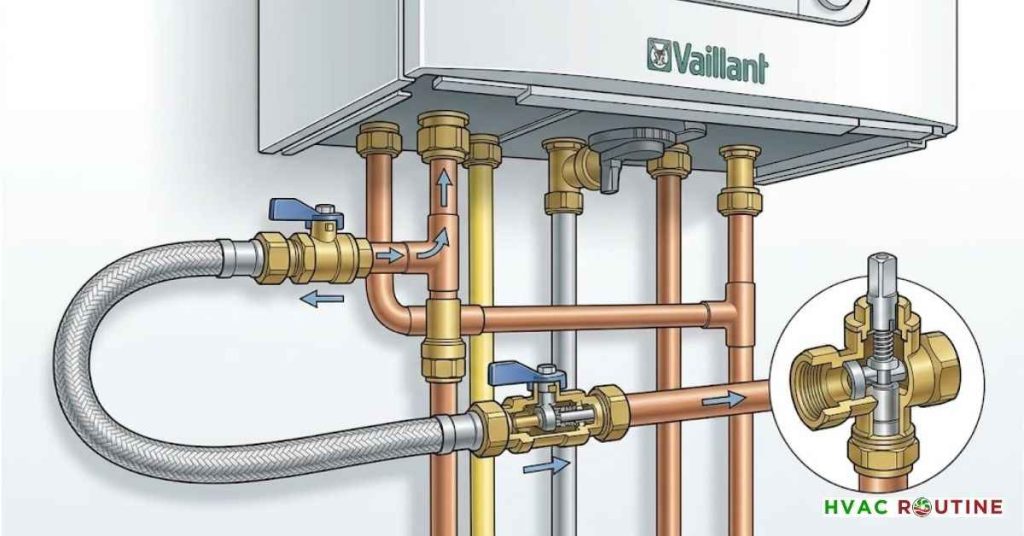
Repressurize Vaillant Boiler Systems via the Filling Loop Valve
Look underneath your unit to find the silver flexible pipe known as the filling loop. This pipe connects your cold mains water line directly to your central heating loop. Inspect both ends of the hose to confirm tight screw connections.
Turn the small lever handle on the right valve to a ninety-degree angle. Turn the left lever handle slowly until you hear water rushing through the pipework. Keep your eyes on the pressure gauge as the needle moves upward.
Shut both levers completely once the gauge reaches 1.5 bar.
Disconnect the loop or stow it away according to your owner manual instructions.
| SAFE PRESSURE ZONE: 1.0 TO 1.5 BAR | |
|---|---|
| Pressure Range | System Status |
| 0.0 – 0.5 Bar | Low Pressure (Triggers F22 Error) |
| 1.0 – 1.5 Bar | Normal Cold Operating Pressure |
| 1.8 – 2.5 Bar | Normal Hot Operating Pressure |
| 3.0+ Bar | High Pressure (Triggers Safety Relief) |
Bleeding Radiators and Correcting Water Drop
Trapped air inside your radiators prevents rooms from heating up evenly. Using a bleed key releases this air, but it also lowers overall system pressure.
You will often see a radiator bleeding pressure drop right after servicing your radiators.
Always check your main pressure gauge after releasing air from top-floor radiators. Top up the water loop using your filling valve to return pressure back to 1.5 bar.
Why Your Central Heating Pressure Loss Keeps Happening
Identifying Micro-Leaks at Radiator Valve Packing Nuts
Water leaks account for most cases of sudden central heating pressure loss. Even tiny leaks can cause significant pressure drops over several days. Inspect every radiator valve in your home using a dry paper towel.
Check for damp spots around brass nuts, joint elbows, and pipe entry points. Tighten loose packing nuts slightly with an adjustable wrench to stop slow drips. If you need a permanent Vaillant boiler F22 fault code fix, check every pipe connection for tiny leaks.
Testing for Pressure Sensor Lockout Issues
Sometimes your system maintains plenty of water, but the control board receives incorrect data. Heavy sludge buildup inside internal pipework blocks the narrow sensor port. This blockage stops the sensor from measuring actual system pressure.
If your analogue gauge shows 1.5 bar while the screen flashes F22, your sensor needs cleaning or replacement.
F22 vs F75 Error Code Differences Explained
Why Low Water Pressure Triggers Multiple Errors
Homeowners often confuse the F22 warning with other system fault lights. Understanding the difference between an F22 vs F75 error code saves you time during troubleshooting. The F22 light means static water volume dropped below safe operational limits.
The F75 code means the system pump turned on, but the sensor detected no pressure jump.
| FAULT CODE DIAGNOSTIC CHART | ||
|---|---|---|
| Fault Code | Primary Symptom | Primary Cause |
| F22 | No static water pressure | Water leak or low volume |
| F75 | No pressure change on start | Failed pump or sensor |
Choosing the Correct Repair Path
If your screen flashes F22, you only need to add water via the fill hose. If your unit displays F75, adding water will not solve the underlying problem. An F75 fault usually demands a pump replacement or a deep system flush.
Advanced Plumbing Issues Behind Chronic Pressure Drop
Expansion Vessel Failure and Pressure Relief Valve Leak
An internal rubber membrane separates air and water inside your system expansion vessel. When this rubber membrane ruptures, the vessel fills completely with water. Heating water expands during normal operation, raising system pressure too high.
The safety valve opens and discharges excess water outside your house. This pressure relief valve leak leaves your system empty once the pipes cool down again. An expansion vessel failure requires professional equipment to recharge or replace.
When a Gas Safe Engineer Boiler Repair Becomes Necessary
You can safely top up water pressure on your own.
However, opening the main front casing of a gas appliance requires professional licensing. Contract a licensed technician whenever internal components require testing.
A certified Gas Safe engineer boiler repair ensures your home stays safe from gas leaks and water damage. Manufacturers require official inspection records to keep your active product warranty valid.
Key Action Steps to Keep Your Heating System Running Smoothly
Simple Monthly Maintenance Practices
Set a reminder on your smartphone to inspect your pressure gauge on the first day of every month. Keep your radiator bleed key hanging on a hook near your main utility panel. Take immediate action if you notice a drop of 0.2 bar over a single week.
Addressing minor pressure drops early keeps your home warm through the coldest winter months.
FAQ
Your boiler shuts down automatically to protect its internal heat exchanger from overheating without water.
Most homeowners can resolve this error in minutes simply by adding water through the filling loop.
However, if your system drops pressure repeatedly every few days, a hidden pipe leak or failing part needs attention.
Vaillant units require at least 1.0 bar of cold water pressure to circulate heat efficiently.
When the pressure sensor detects a reading below 0.3 bar, it triggers an immediate safety shutdown.
This safety feature stops the burner from firing while dry, protecting internal components from thermal stress.
It acts as a digital circuit breaker that cuts off heating and hot water production instantly.
The code remains on your display screen until you manually top up system water volume and press reset.
Think of it as your heating unit’s automatic way of asking for more water before resuming normal operation.
Turn both valve lever handles slowly until you hear water filling the internal pipe network.
Watch your display screen carefully until the digital readout reaches 1.2 to 1.5 bar.
Close both levers tightly, then hold the front panel reset button for three seconds to restart your burner.
Still have more questions?

1 thought on “Vaillant Boiler F22 Fault Code Fix: Complete DIY Guide”